
It’s hard for me to fathom just how busy Daniel Lombroso has been in the last decade. The New York-based filmmaker spent four years embedded with white nationalists for his gripping feature 2020 doc debut White Noise. Prior to joining The New Yorker as a filmmaker in 2020 he made a number of films for The Atlantic; altogether he has directed five films and produced another handful. His subjects range from an examination of Brazilian butt lifts to a haunting portrait of the Mexican American border. His films are always both compelling and stylish. He knows how to tell a good story.

Since I met Lombroso at London’s Raindance Film Festival a few years ago, he has been unceasingly generous with his time. More than once he has woken early to zoom into my London classroom, conducting Q&As with budding filmmakers, before he begins his own working day.
This autumn marked the launch of Lombroso’s first autobiographical film. In Nina & Irena, Lombroso movingly explores his own family history through the gentle grilling of his reticent grandmother Nina. A Holocaust survivor, she has never spoken about losing scores of her relatives, including her sister Irena. Executive produced by Errol Morris, the short film is a serious contender for the upcoming Oscar nominations.
A couple of weeks ago Lombroso again joined me for an early morning zoom, to talk about Nina & Irena with my 2nd year Royal Holloway University documentary students. He spoke candidly about many things, including the launching of the film into a toxic internet in the first weeks of the Israel-Hamas war.
This transcript of our session, which includes questions from my students, has been edited for length and clarity:
I am always interested in filmmakers who make a few films and then come to an autobiographical subject. Can you talk us through the origins – how long you’ve been kicking around this idea that you wanted to make a film about your grandmother before – as you acknowledge in the film – it’s too late?
Daniel Lombroso: I think it’s hard to make a good personal film. It’s many people’s first inclination to make a personal film because it’s the easiest lift. But even if I wanted to make something personal in my life, I would always exclude myself from the narrative. I would make films that I was interested in, but you wouldn’t know about my connection to the material.
I spent four years embedded with white nationalists, neo-Nazis all over the US, France, Russia, Belgium, Canada. It was all-consuming. And if you watch White Noise, you would not know that the filmmaker is Jewish. You would not know that the filmmaker is the grandson actually of two Holocaust survivors.
And the reason I made that work is, of course, because of my family history. Because I understood the importance of paying attention to those sorts of groups and taking them seriously. But I just never felt like it would advance the story in any way to know about me. So I excluded myself. And the same goes for a lot of my work. You’ll Be Happier is about one woman’s struggles with her body image, and ultimately her body dysmorphia. And hearing from a male filmmaker in a film like this would have taken away from the experience and made it less sensitive, ultimately. So I excluded myself from that story. And I’ve done that many times. I made a film about the border wall called American Scar and hearing from me wouldn’t have done anything.
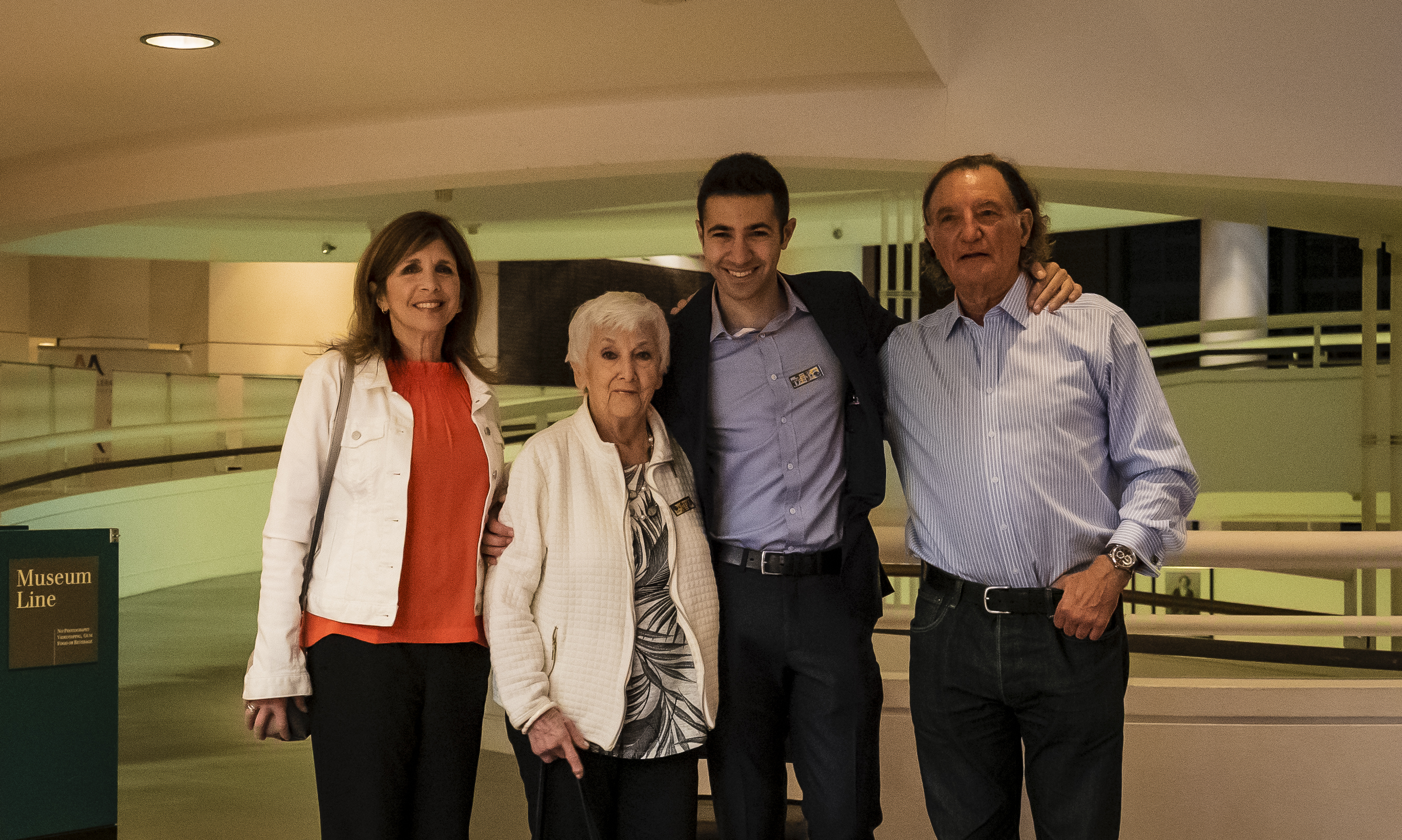
For Nina & Irena, this is the one time when I felt like it had an important narrative utility that actually advanced the plot. If you just heard from this grandmother, like any Holocaust testimony, it would be helpful, but I don’t think it would be moving in the same way. And this film, for me, is about a few things. But one of them is about the intense bond between any grandparent and their grandchild. And the idea is that hopefully when you see me, that all of you guys could map yourselves onto me and see yourself in that relationship. So the hope is that if you see me walk in the door as the guilty grandson who doesn’t visit his grandmother enough, that some of you guys can see yourself in that. And I don’t think it’s a Jewish story – it’s supposed to be a universal one. Anyone who has a relative who didn’t talk about their trauma or something that they went through, it’s never too late to ask those questions of your family and your loved ones.
Can you talk us through a little bit about the approach to how you made it and how you navigated putting yourself in it?
DL: The film is very controlled. This is a portrait of a woman at the end of her life who lives a vibrant life. She’s playing bridge and doing yoga and has five, six grandkids and five great grandkids. But she’s also kind of hiding this hidden truth, this secret in the family that’s never been spoken about. So it was a chance for me to raise the cinematic bar – to do something that was a little more elevated because there’s time to think.
What I noticed right away is that my grandmother was resisting. And rather than fight it, I kind of leaned into that and realized that that is the story – that the resistance is the story. And I think a lot of filmmakers, and certainly me earlier in my career have felt like we’ve succeeded when the main subject cries – the cry is what every filmmaker looks for. But I actually think what makes this so much more interesting is that she’s resilient and she doesn’t cry and she keeps moving and she fights with me.
I really like the difference between the black and white footage and the present day footage. What was your intention in including scenes like her trying to figure out Netflix?
DL: I wanted to find a way to make a Holocaust film in a different way. I think at this point there are certain tropes that people expect. People expect testimony and a lot of death and train tracks and crematorium. The horrors of the Holocaust are important and should not be neglected and they’re a part of this film.
But I wanted to focus on her humor and the vibrancy of her contemporary life. I wanted to find a way to contrast the richness in the comedy of the now with the horror of the past. And I think one tactic in that which we found in the edit was to delay the story of the Holocaust as long as possible. You only really step back in time like maybe six minutes or seven minutes in.
The other thing is that I think people feel like it’s ancient history but it’s not: it’s not a long time. I started filmmaking 15 years ago but it feels like yesterday. So it was important for me to find archive that is pristine and almost kind of flawless.

What was it like releasing the film in the last few days?
DL: October 7th was the deadliest day for Jews since the Holocaust. And since then we’ve seen just a horrible response for Palestinians in Gaza. My grandmother has nothing to do with Israel. She’s been there once. You hope that people watch the film and listen to her message. Her message is one of humanism that every life matters and every death is a tragedy.
We’ve seen what social media looks like the past month and it’s disgusting, to put it frankly. The people who watch the film with an open mind I think are very moved by it. I’ve gotten so many notes from Arab and Palestinian friends.
But a lot of people who don’t watch the film or watch it superficially have just been disgusting. For people who believe antisemitism doesn’t exist I would encourage you to look at the trailer for the film on The New Yorker’s Instagram page and see the hundreds of people who claim that the Israeli government manufactured my grandmother and wheeled her out as a way to manufacture consent for their war. Which is like the most ridiculous thing in the world. Her message in the film is if we lose our humanity we lose everything. Hopefully people can channel Nina a little bit and be warm and open-minded and love everyone and hold space for everyone.


 Docs on Screens